India’s 500 GW Renewable Energy Target by 2030: What It Means for Businesses
India aims for 500 GW of renewable energy by 2030. Explore what this means for businesses, key growth sectors, and the opportunities shaping India’s clean energy future.
3/19/20263 min read
India’s 500 GW Renewable Energy Target by 2030 — What It Means for Business
India’s Most Ambitious Energy Goal Yet
When India stood on the global stage at COP26 and committed to reaching 500 GW of non-fossil fuel energy capacity by 2030, it wasn’t just another climate announcement. It was a signal — to industries, investors, and businesses — that the country is accelerating into a clean energy future faster than ever before.
This target is huge. In fact, it’s more than double where India stands today in terms of renewable capacity. But beyond the numbers, what really matters is what this shift unlocks: massive opportunities for businesses across sectors.
What Does 500 GW Actually Mean?
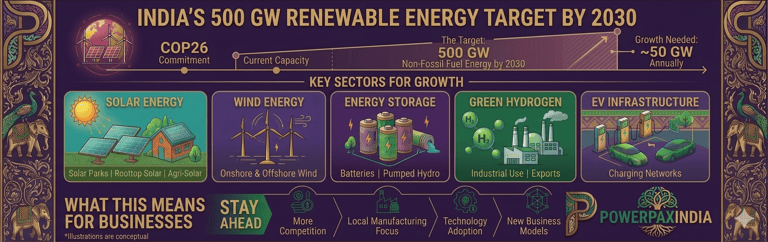
To put things into perspective, India needs to add roughly 50 GW of renewable energy every year between now and 2030.
Right now, that pace isn’t quite there. In 2023–24, the country added about 18 GW. So, we’re looking at a situation where growth needs to almost triple.
That gap? That’s where opportunity lives.
It means more projects, more demand, more innovation—and a much bigger role for private players.
Where the Growth Is Happening
This transition won’t rely on just one energy source. It’s going to be spread across several fast-growing sectors.
Solar energy is leading the charge. From massive solar parks to rooftop installations in homes and factories, solar is becoming more accessible and affordable. There’s also growing interest in areas like floating solar and agri-solar, especially in rural India.
Wind energy is picking up again too. While onshore wind has been around for a while, offshore wind is now entering the conversation, opening up entirely new investment possibilities.
Then there’s energy storage, which is quickly becoming essential. As renewable energy grows, so does the need to store it efficiently. Batteries and pumped hydro systems will play a key role in keeping the grid stable.
Another exciting space is green hydrogen. India is betting big on it—not just for domestic use, but also as an export opportunity. Industries like steel and refining are already exploring how to integrate it.
And finally, EV charging infrastructure is expanding rapidly, especially as electric vehicles become more common. Clean energy and clean mobility are now closely linked.
Policy Support Is Driving Momentum
One of the biggest reasons this transition feels real—not just aspirational—is the policy backing behind it.
The government has rolled out multiple initiatives that are actively pushing demand:
Rooftop solar schemes for households
Solar programs supporting farmers
Incentives to boost domestic manufacturing
Clear renewable purchase obligations for industries
A national push for green hydrogen
All of this creates a strong foundation. It tells businesses that this isn’t a short-term trend—it’s a long-term direction.
A $300 Billion Opportunity
Reaching 500 GW won’t come cheap. It’s expected to require over $300 billion in investment over the next decade.
But that’s exactly what makes it exciting.
This investment will flow into everything—from manufacturing solar panels and building wind turbines to upgrading transmission networks and developing storage solutions.
For businesses, it’s not just about entering the renewable space. It’s about finding your place within a rapidly expanding ecosystem.
What This Means for Businesses
If you’re in manufacturing, energy, infrastructure, finance, or even technology—this shift will affect you.
We’re likely to see:
More competition, including global players entering India
Greater focus on local manufacturing and supply chains
Faster adoption of new technologies
New business models emerging around energy services
In other words, the rules of the game are changing.
Companies that move early, adapt quickly, and align with this transition will have a clear advantage.
How to Stay Ahead
The challenge isn’t just understanding the opportunity—it’s staying connected to how fast things are evolving.
This is where industry platforms and events become valuable. They give you a real sense of what’s happening on the ground—what technologies are emerging, who the key players are, and where the market is heading.
Events like PowerPax India 2026 bring together stakeholders from across the energy ecosystem. Whether you’re looking to explore partnerships, understand policy shifts, or spot the next big trend, being part of these conversations can make a real difference.
The Bigger Picture
India’s 500 GW renewable energy target isn’t just about hitting a number by 2030. It’s about reshaping the country’s energy future—and creating one of the largest clean energy markets in the world.
For businesses, this is a defining moment.
The question isn’t whether the transition will happen. It’s how quickly—and whether you’re ready for it.
Contact
Reach Out for other Information and Queries
Gaurav Dubey: +919818575520
Neha Chauhan: +91 7428 693331
Office Number : +91-120-162126
Office Number : +91-120-5163087
Tresub Media Pvt Ltd
Gaur City Mall 14th Floor
(Office No. 14130,14130-A), Sector-04 ,
Greater Noida West -201318,
Uttar Pradesh, India
Email ID : neha@renewablemirror.com
Web : www.renewablemirror.com/
© 2026. All rights reserved.
